

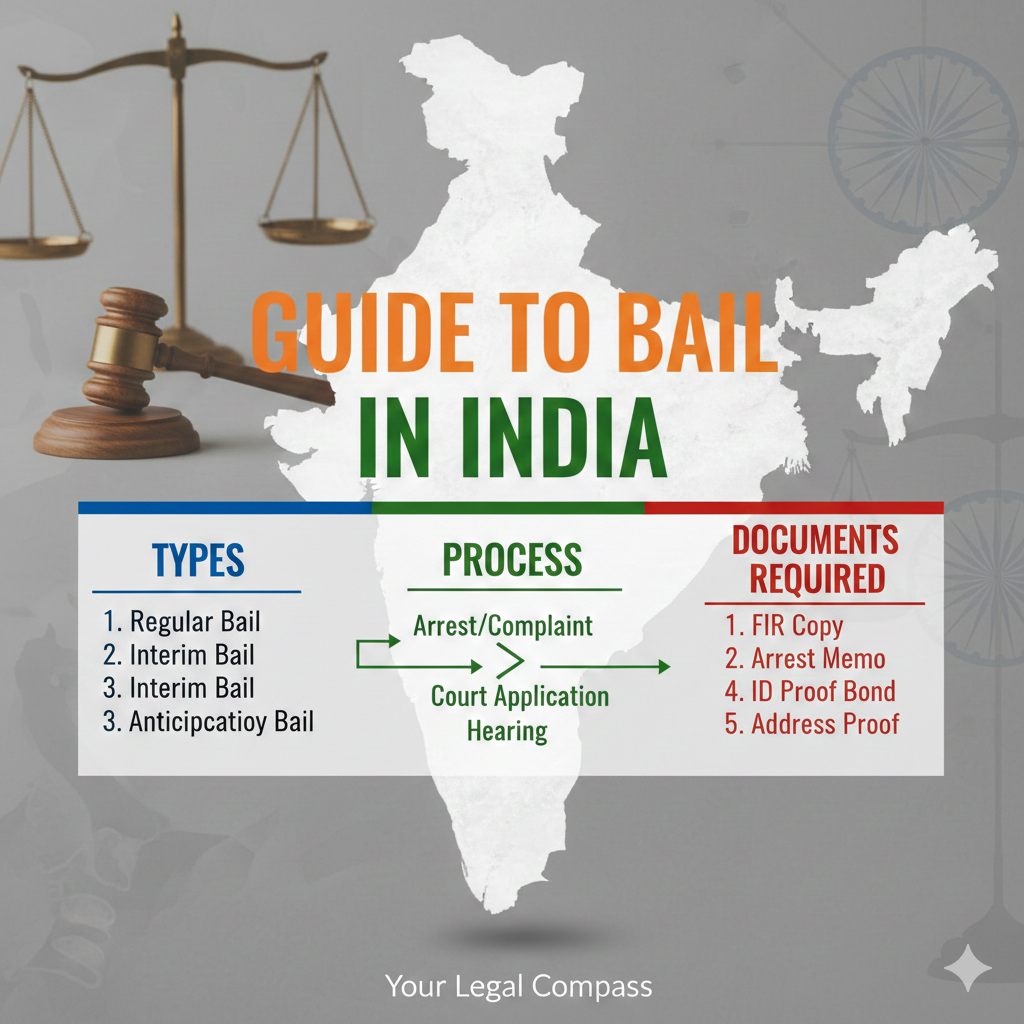
Guide to Bail in India: Types, Process & Documents Required
Introduction
Bail is one of the most important legal protections in the Indian criminal justice system. It ensures that an accused person does not stay in custody unnecessarily while the case is pending.
However, many people misunderstand what bail is, who can get it, what types of bail exist, and which documents are needed.
This guide explains:
What bail means
Types of bail
How to apply for bail
Documents required
Important legal principles
Common mistakes to avoid
What is Bail in India?
Bail is the temporary release of an accused person from custody, with an assurance that they will appear before the court whenever required.
Legally, bail is linked to the right to personal liberty under Article 21 of the Constitution of India.
Types of Bail in India
1. Regular Bail
Granted to a person already arrested and in police or judicial custody.
Common sections:
Section 437 CrPC – Bail by Magistrate
Section 439 CrPC – Bail by Sessions Court / High Court
Used in cases of non-bailable offences after arrest.
2. Anticipatory Bail
Granted before arrest, when a person fears they may be arrested in a non-bailable offence.
Legal provision:
Section 438 CrPC – Anticipatory Bail
Common in cases involving:
Matrimonial disputes (498A)
Business disputes
Property disputes
Personal conflicts
Prevents arrest and protects personal liberty.
3. Interim Bail
A temporary form of bail granted until the final hearing of regular bail or anticipatory bail.
Useful when immediate protection is needed.
4. Default Bail (Statutory Bail)
Available when police fail to file a charge sheet within the statutory time limit.
Time limits:
60 days – for offences punishable up to 10 years
90 days – for offences punishable with death, life imprisonment, or 10+ years
Legal Basis: Section 167(2) CrPC
Bailable vs Non-Bailable Offences
Bailable Offences
Bail is a right.
Police must release the person on bail.
Magistrate cannot refuse bail.
Examples:
Simple hurt
Public nuisance
Minor offences
Non-Bailable Offences
Bail is at the court’s discretion.
Serious offences.
Examples:
307 Attempt to Murder
376 Rape
420 Fraud (depending on case)
498A Cruelty
Courts consider the severity, evidence, & criminal history.
Bail Procedure in India (Step-by-Step)
1. Consult an Advocate
A bail petition must be drafted and filed by a criminal lawyer.
2. Draft & File Bail Application
Bail application includes:
FIR details
Arrest/custody status
Grounds for bail
Previous criminal record (if any)
Reasons for false implication
Applications are filed before:
Magistrate (for regular bail)
Sessions Court (serious offences)
High Court (anticipatory bail / rejected bail)
3. Notice to Public Prosecutor
Court seeks objections from the police/prosecution.
4. Hearing Before Court
Court examines:
Nature of offence
Evidence
Risk of absconding
Threat to witness
Possibility of tampering evidence
5. Court Order on Bail
Court may:
Grant bail
Reject bail
Impose conditions (passport deposit, surety, etc.)
Documents Required for Bail in India
✔ Copy of FIR
Essential for drafting bail.
✔ Arrest Memo / Notice Under Section 41A (if applicable)
Shows custody or arrest procedure.
✔ ID Proofs of Accused & Surety
Aadhaar, PAN, Voter ID, etc.
✔ Surety Documents
Proof of financial capability:
Property papers
Salary slips
Bank statements
✔ Address Proof
To ensure the accused won’t abscond.
✔ Supporting Documents
Depending on case:
Medical records
Marriage certificate
Business documents
Settlement deed (Compromise cases)
✔ Affidavits
Sworn statements supporting the bail application.
When Can Bail Be Denied?
Court may reject bail if:
Offence is serious (murder, rape, terrorism)
Accused may abscond
Evidence may be destroyed
Threat to witnesses
Previous criminal record
Public interest or safety concerns
Important Supreme Court Guidelines on Bail
Bail is the rule, jail is the exception.
Courts must consider personal liberty first.
Delay in trial is a strong ground for bail.
Cases based on weak evidence should not result in long custody.
Common Mistakes to Avoid in Bail Cases
❌ Not hiring an experienced criminal lawyer
❌ Hiding previous criminal records
❌ Giving false information in the bail application
❌ Not providing strong sureties
❌ Delaying anticipatory bail
❌ Not cooperating with investigation
Conclusion
Bail plays a crucial role in protecting personal liberty and ensuring fairness in criminal proceedings. Understanding the types of bail, procedures, and documents required helps the accused and families handle the situation confidently and legally. Consulting a skilled criminal lawyer is essential to secure bail effectively.