

Introduction
Recording phone calls has become common for business proof, harassment cases, threats, loan recovery abuse, family disputes, and fraud protection. However, many people are unsure:
👉 Is it legal to record a phone call in India?
👉 Can recorded calls be used as evidence in court?
This guide explains what Indian law allows, what is illegal, privacy concerns, and how to legally record calls in India.
Is Call Recording Legal in India?
✅ Yes, but with conditions.
India does not have a specific law banning call recording. However, legality depends on:
Consent
Purpose
Use of the recording
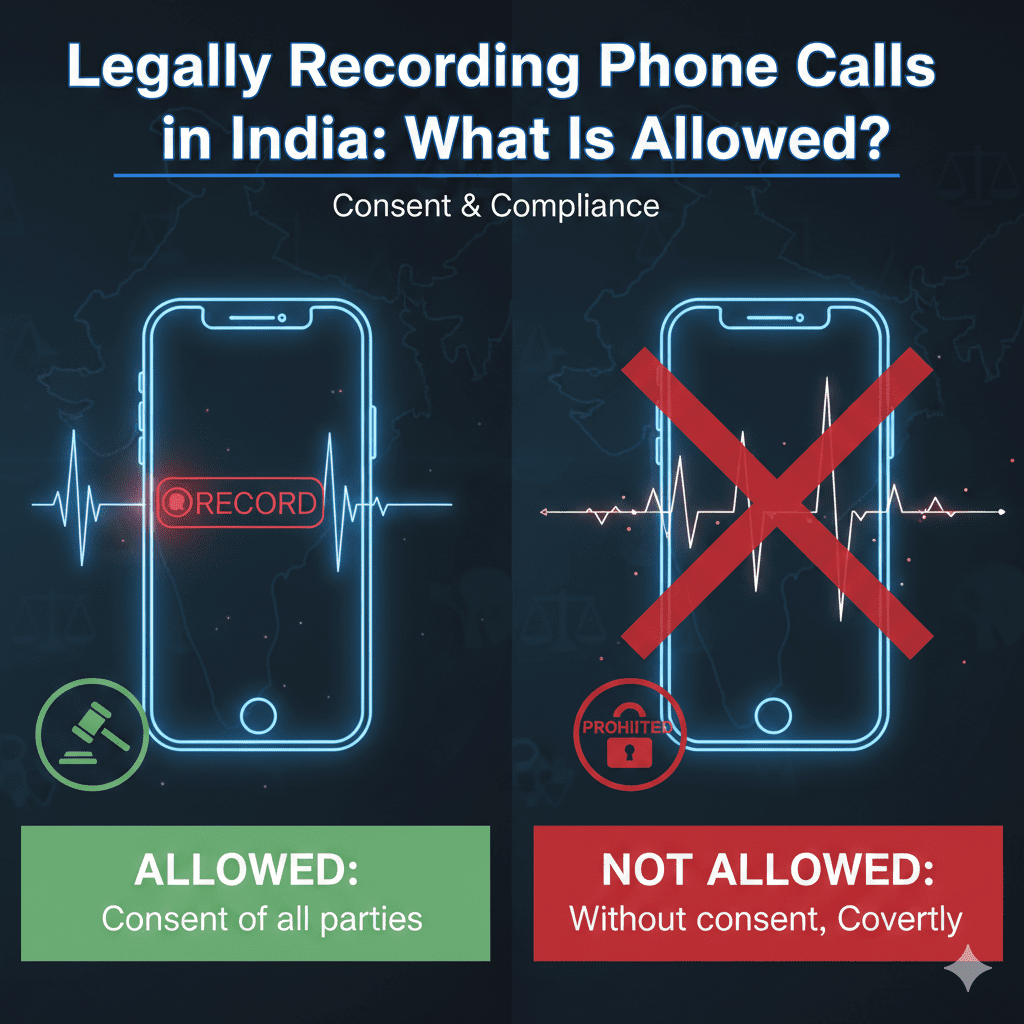
Key Legal Principle: One-Party Consent
India follows a one-party consent rule in most situations.
👉 If you are a participant in the call, you can legally record it for personal protection or evidence.
You cannot secretly record calls between two other people.
Laws Governing Call Recording in India
1. Right to Privacy (Article 21 – Constitution of India)
The Supreme Court recognizes privacy as a fundamental right.
Call recording must not violate reasonable expectation of privacy.
2. Indian Telegraph Act, 1885
Only government-authorized interception is regulated.
Personal call recording by a participant is not illegal under this Act.
3. Information Technology Act, 2000
Illegal use of recorded calls (misuse, harassment, blackmail) can attract penalties.
4. Indian Penal Code / Bharatiya Nyaya Sanhita
Using recordings for:
Blackmail
Defamation
Threats
is punishable.
When Call Recording Is LEGAL in India
✅ Recording your own phone call
✅ Recording for self-protection or evidence
✅ Recording threats, abuse, or harassment
✅ Recording business or payment discussions
✅ Recording loan recovery harassment
Such recordings are legally allowed.
When Call Recording Is ILLEGAL
❌ Recording calls between third parties
❌ Recording for blackmail or extortion
❌ Recording to defame someone
❌ Publishing recordings without legal purpose
❌ Tampering or editing recordings
Illegal usage can attract criminal liability.
Can Recorded Calls Be Used as Evidence in Court?
✅ Yes.
Call recordings are admissible as electronic evidence under:
Section 65B of the Indian Evidence Act
Requirements for Court Admissibility
Original recording device
Unedited audio
Proper 65B Certificate
Clear relevance to the case
Is Consent of the Other Person Required?
Not mandatory if you are part of the call
Mandatory if recording someone else’s conversation
Informing the other party is recommended but not compulsory in personal safety cases.
Call Recording in Specific Situations
1. Workplace & Employer Calls
Allowed if you are a participant.
Illegal if used to leak confidential data.
2. Spouse or Relationship Disputes
Legal for evidence of threats or abuse.
Illegal if used for harassment.
3. Loan Recovery Harassment
Recording recovery agent calls is fully legal and recommended.
4. Business & Contract Disputes
Recorded calls can prove:
Payment terms
Admissions
Agreements
How to Safely Record Calls Legally
✔ Record only your own calls
✔ Do not edit recordings
✔ Keep original files
✔ Do not share publicly
✔ Use only for legal protection
Legal Risks of Misusing Call Recordings
Misuse may lead to:
Defamation cases
Cyber crime complaints
Privacy violation claims
Use recordings responsibly and legally.
Why Consult a Lawyer Before Using Recordings?
A lawyer ensures:
Admissibility in court
Privacy compliance
Protection from counter-cases
Conclusion
Recording phone calls in India is legal when done responsibly and for lawful purposes. If you are a participant in the call, recording for evidence or protection is generally allowed. However, misuse can lead to serious legal consequences.
FAQs
Q1. Is it legal to record phone calls without informing the other person?
Yes, if you are part of the call and use it lawfully.
Q2. Can recorded calls be used in court?
Yes, with a valid Section 65B certificate.
Q3. Is call recording allowed for harassment cases?
Yes, it is recommended as evidence.
Q4. Can I publish recorded calls online?
No, that may violate privacy laws.