

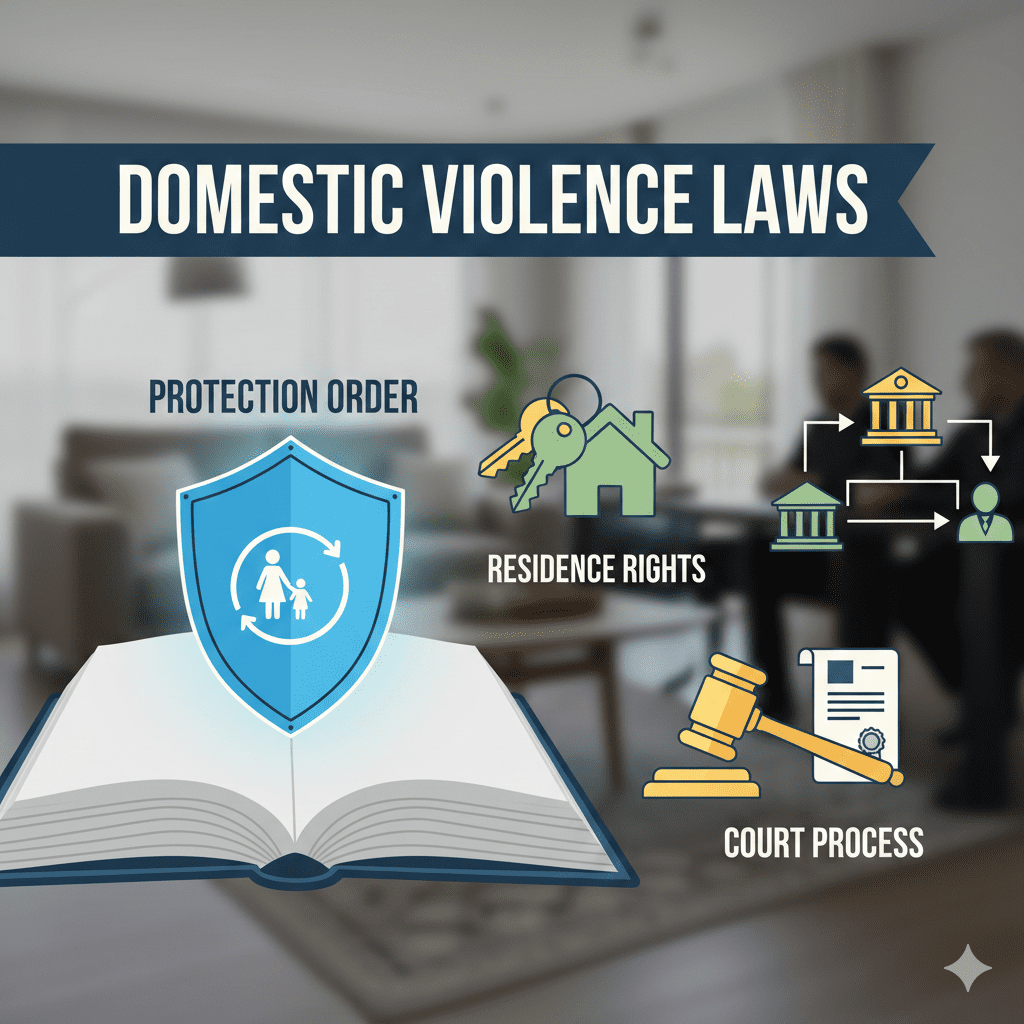
Domestic Violence Laws in India: Protection Order, Residence Rights & Court Process
Introduction
Domestic violence is one of the most common yet underreported crimes in India. To protect women from physical, emotional, sexual, verbal, and economic abuse, the Government of India enacted the Protection of Women from Domestic Violence Act, 2005 (PWDVA).
This law provides powerful civil remedies such as Protection Orders, Residence Rights, Monetary Relief, Custody Orders, and Compensation, without waiting for a criminal trial.
This detailed guide explains domestic violence laws in India, focusing on protection orders, residence rights, and the complete court process, along with strong legal insights.
What Is Domestic Violence Under Indian Law?
Under Section 3 of the Domestic Violence Act, 2005, domestic violence includes:
Physical abuse
Emotional and mental abuse
Verbal abuse
Sexual abuse
Economic abuse
Threats, coercion, and harassment
Even one incident is sufficient to file a domestic violence case.
Who Can File a Domestic Violence Case?
A domestic violence complaint can be filed by:
Wife (including separated wife)
Live-in partner
Divorced woman (if abuse occurred during marriage)
Any woman in a domestic relationship
Complaint can be filed even if the woman is not living with the abuser currently.
Protection Order Under Domestic Violence Act
What Is a Protection Order?
A Protection Order is issued by the Magistrate to prevent further acts of domestic violence.
Key Provisions of Protection Order (Section 18 PWDVA):
Court may restrain the respondent from:
Committing domestic violence
Contacting or threatening the woman
Visiting her workplace
Communicating through calls/messages
Alienating assets
Entering the shared household
Violation of a protection order is a criminal offence, punishable with imprisonment.
Residence Rights of Wife Under Domestic Violence Law
Right to Shared Household (Section 17 PWDVA)
A woman has the legal right to reside in the shared household, regardless of:
Ownership of property
Whether property is in husband’s name or in-laws’ name
Court Can Order:
No eviction of wife
Alternative accommodation
Rent payment by husband
Restraining husband/in-laws from disturbing possession
This right exists even if the woman does not own the property.
Monetary Relief & Maintenance Under Domestic Violence Act
Section 20 – Monetary Relief
Court can order payment of:
Monthly maintenance
Medical expenses
Rent and accommodation expenses
Loss of earnings
Child maintenance
This is in addition to maintenance under Section 125 CrPC.
Custody of Children (Section 21 PWDVA)
Temporary custody of children can be granted to the mother to ensure safety and welfare.
Compensation for Domestic Violence (Section 22)
Court may award compensation for mental torture, emotional distress, and trauma suffered by the aggrieved woman.
Domestic Violence Court Process (Step-by-Step)
Step 1: Filing of Complaint
Complaint can be filed:
Before Magistrate
Through Protection Officer
Through NGO
Directly by the victim
No court fee required.
Step 2: Domestic Incident Report (DIR)
Protection Officer prepares a Domestic Incident Report, which supports the complaint.
Step 3: Issuance of Notice
Court issues notice to the respondent.
Step 4: Interim Orders
Court may grant:
Interim protection order
Interim residence order
Interim maintenance
Step 5: Evidence & Arguments
Affidavits, documents, and oral arguments are considered.
Step 6: Final Order
Court passes final orders on:
Protection
Residence
Maintenance
Compensation
Custody
Time Frame for Domestic Violence Cases
The Act mandates disposal within 60 days, though timelines may vary.
Is Domestic Violence a Criminal Case?
Domestic Violence Act is civil in nature
Breach of protection order becomes criminal offence
DV case can run parallel with:
Section 498A IPC
Maintenance cases
Divorce proceedings
Documents Required for Domestic Violence Case
Marriage proof
Address proof
Medical reports (if any)
Photographs / recordings
Messages / call records
Income proof of husband
Domestic Incident Report (if available)
Why Hire a Domestic Violence Lawyer in Delhi?
A domestic violence lawyer helps in:
Drafting strong complaint
Securing urgent protection orders
Ensuring residence rights
Obtaining maintenance quickly
Handling false counter-cases
Appearing before Magistrate efficiently
The Domestic Violence Act, 2005 is a powerful law designed to protect women from abuse within domestic relationships. With remedies like protection orders, residence rights, maintenance, and compensation, women can seek immediate legal relief without waiting for criminal trials.
Timely legal action and expert guidance can ensure safety, dignity, and justice.